
Editors Note: This review was originally posted on Linuxslate.com in April of 2006. It has been moved here by the original author with current edits. Discussions on some other devices will remain on the Linuxslate.com Forums at least for now. Please check there for additional Reviews, and Discussion.
The DRSB-88 is a very compact Vintage Radiation Detector that was made in Russia. I purchased it on eBay. After reading a nice review of another model – The DRSB-01, and finding no other information about such devices elsewhere, I decided to write a review of my own.

The unit is one of the the smallest (and least expensive) true Geiger Counters I have ever seen. [Ed: At the time of the original article] What I wanted was something small and easy to carry. The obvious device for such a purpose is a Dosimeter. I am very glad I got a true Geiger Counter instead. What’s the difference? See Link Below.
The DRSB-88 is almost as small as a Dosimeter, yet uses a common, easily replaceable battery (One AA Battery.) This may be very important in a Civil Defense emergency. Instead of estimating dose, the DRSB-88 gives indications of individual counts. Background counts soon give assurance that the device is working properly each time you turn it on. It also seems that the battery life is very good.
While somewhat primitive in construction compared to most consumer electronics, it seems fairly sturdy. I have already dropped mine twice from my shirt pocket onto a tile floor, and it is still working fine.
The unit lacks any sort of readout or meter. It’s output is simply a light and a clicker. In the presence of a significant threat, the rather bright light would flash enough to be very obvious. The “click” sound is exactly what people expect from a Geiger Counter. If I am near anything that produces anything noticeably more than background counts, I am going to take steps to increase the distance between myself and whatever it is as soon as possible. I’ll leave the Milliroentgens, Radiation Absorbed Doses (RADs), and Exposure Limit Charts to the proper authorities. If you want to quantify what you detect, the DRSB-88 and a stopwatch will give counts per minute (CPM).
By the way, does any body know what exactly that light is? It does not look like an LED. Is it some sort of neon bulb? [Update: It is a MTX-90 Russian Miniature Thyratron — It is part of the detection circuitry and since it is neon filled, it also produces the flash. Not only does the term Thyratron sound cool, but the fact that the device has a vintage tube device (in addition to the Geiger-Muller Tube) also adds to it’s nostalgia.]

Sensitivity: With no readout or meter, speaking of “accuracy” is irrelevant. An important thing to note is that the GM (Geiger-Muller) tube in the DRSB-88 is very small. Because of this, fewer ionizing particles are going to pass through it than would pass though a larger tube. My DRSB-88 seems to detect about ¼ the counts as my old Universal Atomics V-700 Commercial Meter. This does not mean the DRSB-88 is inaccurate or not sensitive. 10 times background still means 10 times background, and that means you have a problem.
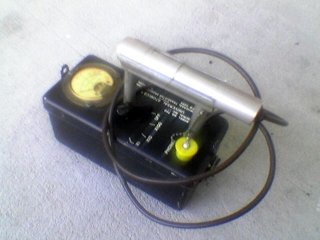
My Universal Atomics V-700
Dr. Covington (reviewer of the DRSB-01 – Website since removed) asked the rhetorical question: Have I found anything radioactive? He did, and So have I. I have a clock out of the instrument panel of an old aircraft. It has a radon painted dial and hands for nighttime viability, and even though it no longer glows, it makes the DRSB-88 go crazy.
Links:
What’s the Difference Between Survey Meters, Geiger Counters and Dosimeters?